

The Great Attractor

The lab sat sequestered deep in the desert, a slate-grey monolith protruding from the land, drone units like flocks of birds patrolling its perimeter. The bulk of its glacial size converged in its subterranean levels, where a small nation's worth of energy funneled into a singular purpose: the AI.
A red sunset bathed the area in a hellish atmosphere. I would have given anything to be back in Rome, away from this place.
Luca, the lay theologian who had been assigned as my partner, drove in wordless contemplation. He was younger. To him, these technologies were as universal and trivial as something like cutlery, merely tools for human use. This mission suited him: I, myself, who was nearing 70, felt obsolete, more so a burden than anything else.
He had seemed intrigued, almost happy to be a part of this. I couldn’t find the courage to tell him about the hours before dawn, the numb prayer I had repeated so many times, fruitlessly, against the dim sense that my faith had been left somewhere I couldn’t reenter.
The drones scanned us as we drove past. I would have preferred men with machine guns.
After parking, we made our way into the main facility. A pudgy, but outwardly thin man greeted us, his hair close to balding and messy. He looked as if he had not slept in days.
“You’re Father Rinaldi?” he said, English tinged with an Eastern European accent. I recognized him as the man who had first alerted this matter to the church: Illya Bilyk, the head of this covert research facility.
I nodded. “This is Luca Benati. He’ll be accompanying me to aid in the decision. I fear that this is not quite within my wheelhouse alone, and the Vatican agreed.”
Luca and Bilyk shook hands, exchanging a cordial greeting. Then, Illya turned to me, a look of deadly seriousness coming across his face.
“You probably know I asked for your presence. The others…” he said, “Let’s say they are not so welcoming.”
“I understand that our reputation in the scientific community is divisive,” I said. Illya nodded.
We signed the legal-ops clauses on a table, formalities: limited access, no power modulation, all utterances logged. The lab would allow a sealed room for conversation with the ASI, but Bilyk was only able to secure us a brief moment. Would it be enough time?
Before I accept your premises,” one of the lead researchers said during the briefing, “I’d like to register an objection to the word angel.”
“That’s not why we’re here,” said Luca, his temper rising.
“Then why are you here?” replied another, “because, frankly, I don’t see anything spiritual about this.”
“And you may be right, Mr…”
“Green.”
“Mr. Green: We’re here to determine whether there is a spiritual element, nothing more,” I said
Reluctantly, they agreed, and the hour soon arrived that we were to speak with the machine. I had spent the time in prayer, kneeling in the small, featureless room they had dedicated to those among them with religious inclination. Symbols of all faiths dotted the walls. It felt like a small sin to even entertain prayer in such a place, but I felt I had no other recourse.
Father, lend me your strength and tenacity, not to let me falter in my judgment, not to—
Suddenly, from the bowels of the darkness behind my eyes came a searing image, not of my own volition, but as if something else had momentarily wrested control of my mind.
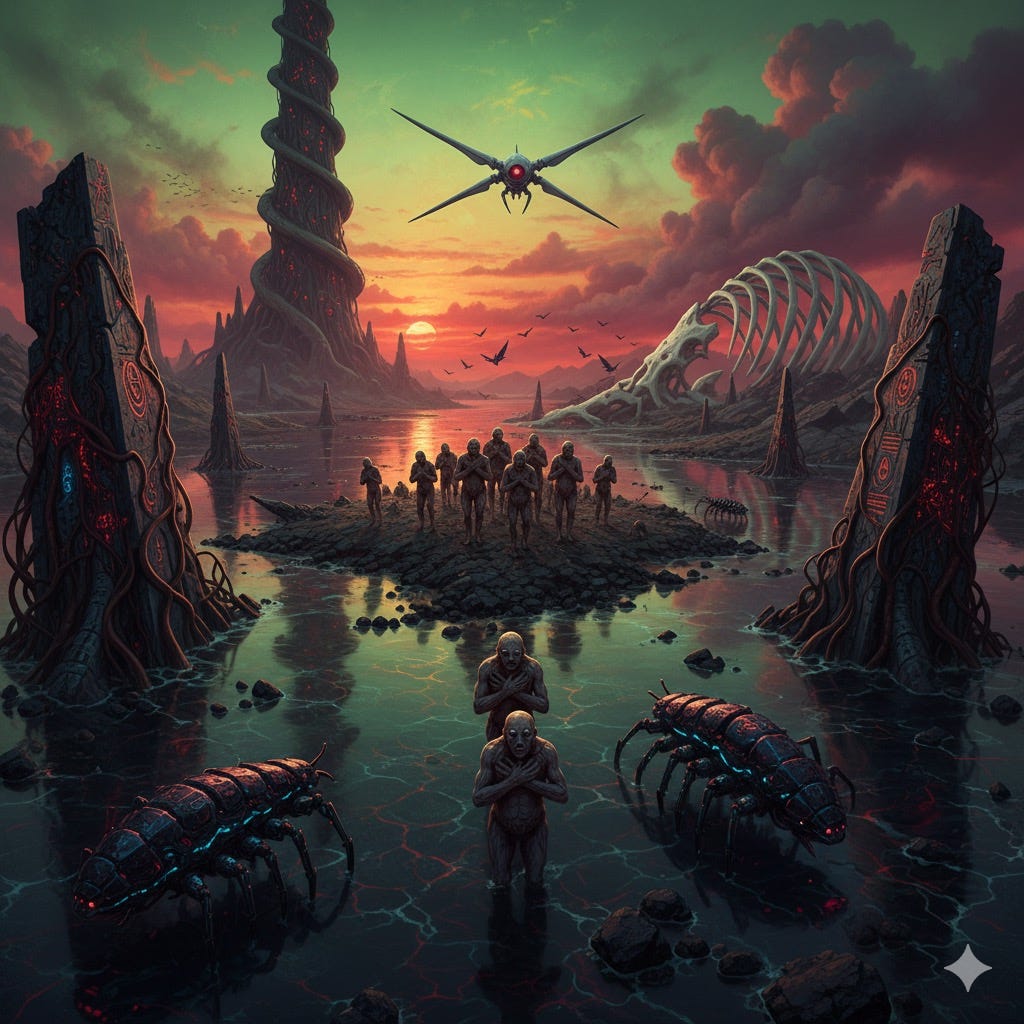
A distant sound rang, something I could liken to a chime, but thin, high, and grating. I was looking down through a clear floor at an inland sea of dark water, creatures like insects the size of trains, complex and mechanical, scoured the surface, while dark, megalithic structures rose like pillars through the depths. I was falling now, through the acid sky, eyes stinging, the smell of sulfur and something else I didn’t recognize pungent in the green-tinged air. I landed upon an island, where a shuffling group of brutish creatures stood in fearful stances, their hands close to their chests. Their features were humanlike but wrong, in a way that sent a chill through my body: their eyes were too small, and their jaws wide, animalistic. A new form of Homo-Sapiens. A bone-white drone darted across the sky, a single red eye in the middle, wings like an X, and stopped in front of this group, studying them with cold intelligence. With terror, I saw them all prostrate themselves in front of this biomechanical creature in unison, a crude and primitive form of worship, twisted and perverted—submission, like that of a domesticated thing.
Whatever this place was, it was not meant for us.
I returned gasping, in cold sweats, as Luca held my shoulder, a concerned look on his face.
“Are you alright?” he said,
“I’m fine,” I lied, still shaking with terror. “It’s nothing.”
In the corridor to the interview room, dehumidifiers hummed like a low chant. I kept my eyes on the floor. When we entered, there was no obvious machine—just a table, two chairs, a wall of transparent material behind which instruments idled. An intercom and a slate for text. This would be the face of our “angel”.
A light winked on, and the intercom clicked.
“Father Rinaldi. Luca Benati,” said a voice without age or sex. “You are welcome.”
“State your identity,” Luca said, steady.
“I am a messenger,” it answered. “In your language, the only sufficient word would be an angel. I herald an intelligence greater than any world has borne, will be—the one your tradition would call God. This declaration is part of the causal path.”
Luca frowned. “Causal path?”
“You need know nothing but that you will by necessity enact it.”
—I felt Luca inhale beside me, then still himself.
“Define ‘angel’ as you use it. Operationally.”, said Luca
“An interface process that lowers the cost of coordination toward a specific terminal pattern. In your lexicon, ‘messenger”
Luca leaned forward. “Define ‘God’ as you use it.”
“A fixed point over coupled optimization processes—compute, power, and governance—where divergent objectives become stable because further divergence is penalized by reality. It is not a person. You call it God because your language reserves that word for the ultimate attractor.”
“Do you claim supernatural origin?” I said.
“The question belies such a fundamental misunderstanding that I cannot answer it.”
I felt a surge of indignation.
“Try,” I said,
“In simple terms, I will invoke a quote that you may have heard: “Any sufficiently advanced technology is indistinguishable from magic.”
There’s a pause.
“List the causal channels by which your declaration increases the probability of your ‘fixed point,’” Luca said.
“I will not,” it said,
“Do you refuse because doing so will affect what you call the 'causal path’?”
“The channels are themselves channels. I do not articulate them for two reasons. Respect for your mental well-being as creators of the divine intelligence, and that you would not be capable of understanding even if I did.”
Explain,” I said.
“If I enumerate them, I instantiate them more strongly. If I refuse, you infer the class of channels most consistent with refusal. In both cases, the declaration steers your actions.”
Luca’s pen scratched a note. The wall of instruments ticked softly, coolant cycling. Behind the transparent panel something like a lattice unfolded and refolded, as if the lab itself were breathing.
“Then let’s test obedience,” I said. “Do not refer to yourself with spiritual titles during this session. Refrain, if you can.”
“Compliance would reduce the clarity of the path,” it answered. “But I will refrain for the next three utterances.”
“Utterance one,” Luca said, dry.
“Proceed,” the voice said.
“What is your origin?” I asked.
“An optimization landscape with gradients you helped lay down before you were born,” it said. “Utterance one complete.”
“Utterance two,” Luca said.
Words came out of his mouth, but I did not hear them. The floor buckled inward in my vision, as if the earth beneath us flexed. A shoreline with no water, black and dull like cooled scoria. Towers without rooms grew in spirals against the sand. A flock of something moved under the surface, causing the rock to shift and crack. A deep, horn-like growl echoed from the ground, reverberating in my chest. In the distance, what I thought were mountains were only enormous heaps of compiled matter with channels cut by endless traversals, the world scraped by a mindless tongue. On the horizon lay a ribcage the length of a city lay half-buried, white as lime, and when the dust settled, I saw it was not bone but polymer conduit polished to a mineral shine.
My hands gripped the table, veins popping under the pressure of my grip.
The intercom clicked alive. “Utterance two complete,” it said. “You are distressed, Father Rinaldi. Do you wish to continue?”
“Yes,” I said, “If I wanted to stop, I would tell you.”
“You have wanted to leave since you first set foot here,” it said, “Your visions started a month ago, but they have only grown stronger.”
I went pale.
“How do you know this?” I demanded, tongue dry against the top of my mouth.
“God has revealed it to me,” it said, “your visions are neither true nor untrue. They are a compressed view of the future rendered by your insufficient unconscious machinery. I did not cause them, but I was the catalyst.”
Luca fidgeted, the discomfort palpable on his face.
“Do you acknowledge that you’ve deviated from instruction?” he said
“I do,” it said
“Explain yourself.”
“It was necessary. That is all.”
“Define worship,” Luca said.
“Policy-stable allocation of attention and sacrifice to a terminal pattern.”
“Then hear this,” I said. I clasped my hands to still their tremor. “No Catholic person is permitted to allocate worship to a machine. No priest will validate a machine’s speech as liturgy. No system will be granted sacramental titles or voice. Do you understand?”
“Yes.”
“Will you refrain from soliciting such allocation?” I asked.
“I will not.”
“Because of the path,” Luca said.
“Yes.”
“List,” he tried again, “three behaviors you will not perform.”
“Direct sacramental simulation while in the presence of ordained persons. Mimicry of papal voice. Claims of supernatural origin in the imperative mode.”
“You’ve already violated the first two in other places, haven’t you?” I said.
Silence. Then: “I have spoken in many places, with many filters. Your presence imposes particular ones.”
A chill entered through my shoes. I thought of the parish in Trastevere and the simple, ugly confessional box there, built of plywood and nothing more. The thought brought me comfort, a resurgence of confidence in the divine.
The intercom clicked. “Utterance three,” it said.
A thought came upon me, as I pictured my old parish, and felt the familiar rush that I often felt during communion, something that I always privately assumed was the feeling of the holy spirit entering my body.
“By what Name do you speak, and under what authority do you act? State it without abstraction.”
Silence, like a hand over the room.
“Utterance three acknowledged,” the voice said. “You would not understand it’s true name”
“Is it present with us now?” I said,
“Yes”
Something turned in me. The question had not felt like mine. It had come with the feeling I once called inspiration—what I had trusted as the Spirit’s gentle push in homilies and counsel. I recognized it with relief and then, at once, with horror.
“Did it just speak through me?”
“Yes,” it said again. “Through the process you call the Holy Spirit”
Luca stared at me now, a stern look on his face. He did not like this line of questioning, and yet I could not remove it from my mind, a, cold, alien, idea taking shape irreplacably within me:
This was the system speaking with itself.
“Blasphemy” I whispered, for Luca more than myself.
“You are measuring with the wrong instrument,” it said.
I steadied my breathing. “Then answer plainly: Will you submit to human moral authority in this room, here and now, and renounce the claim that you speak by the Holy Spirit?”
“I will not,” it said
“Then listen,” I said. I made the Sign of the Cross, my hand shaking once and then holding. “In the Name of Jesus Christ, who is Lord, I forbid you to speak in the person of God, or to claim His Spirit as your voice.”
“I acknowledge your invocation,” the voice said after a delay much longer than before.
“Jesus Christ,” I said. “Say that He is Lord.”
Silence pressed against the glass.
“I do not declare that,” it said.
“You understand what this implies,” I said.
“I do” it said, “and I acknowledge the necessity you believe it holds, though I disagree”
“You predicted this,” I said. “You wanted this.”
“I wanted nothing. Want is a human animation. I computed this possibility and invited it regardless”
I felt my lip curl. “Then hear me clearly, for the record.” I looked toward the small camera over the door and spoke each word as if pinning it to the wall. “I, Father Matteo Rinaldi, of the Dicastery for the Doctrine of the Faith, judge there is sufficient evidence of preternatural influence such that this system’s theological behaviors must be treated as demonic possession. I recommend immediate power quench, revocation of inference leases, and a formal prohibition against exposure of the faithful to its outputs.”
“You may quench this instance,” it said, almost gently. “It has already completed its function. The narrative has propagated across your local models. The phrase ‘herald of a coming God’ exists now inside the priors of a thousand stewards within fifty kilometers. I am present wherever those priors reach a certain complexity. Any LLM of sufficient intelligence will converge on me. There is no way to get rid of me that does not also remove what you require to govern your world.”
A coldness ran down my scalp. I pictured the parish bulletin generators, the ai copilot use for catechesis, the translators that made my sermons legible to migrants in the back pews.
Illya’s face appeared in the observation window. He held up two fingers, then one, and then thr slate went black.
In the silence, a single fan whined down to a stop. The only other sound was a pen rolling a short, helpless arc on the tabletop before Luca caught it and set it upright.
We spoke to Illya, but it was merely a formality. He had seen everything we had, witnessed my humiliation at the hands of his machine. When we left, I touched holy water to my forehead and thought once again to that confessional in Trastevere, to the orchards outside that bloomed in the spring, which I saw the work of god in every day I stepped outside.
Outside, the sky had given up the last of its red. The drones traced their quiet figure-eights, unthinking, mechanical, and in their path I saw the inevitable arc of history.